PREVIEW — not launched. Payments open soon — tap Buy on any eBook to save it to your wishlist.
eBookYou

eBooks worth your evening.

eBooks from independent authors, sold direct. Read the first chapter of anything here, free, without giving us an email address.

Aaron Marcus Fellington 7 books

They would give us everything. There was one thing to do first.

· Human Alliance, book 1 · Science Fiction

A machine built to forecast the price of copper found the first message from another civilisation. It filed it as item three hundred and eleven in a queue of four hundred and six.

Read the full descriptionShow less

In March 2030, at an observatory in Ladakh owned by a Luxembourg investment house, Dr Asha Varghese is clearing a queue of low-priority anomalies with a mug of tea going cold. One of them does not repeat at any interval that means anything.

Five months later a proxy of the Lasan Alliance speaks in a boardroom in Kirchberg. It is not a person, it has no name, and it has watched humanity for eleven weeks. It says our species identifies problems reliably, agrees they exist, solves them excellently and executes at scale - and fails at one thing only, which is acting when the acting is expensive to whoever decides.

Then it gives the condition, in ninety-one words, and tells the company to publish it within thirty days.

The company does not publish it. Nobody decides not to. It goes onto an agenda as item seven with fifteen minutes allocated.

This is the story of how the largest fact in human history was mislaid by careful people following excellent procedures - and of the four scientists on a plain at four and a half thousand metres who found it, one of whom is dead by the twelfth of July over the custody of a hard drive.

Told forty years later by the woman who read it. There is no villain anywhere in it, and that is the point.

The aliens arrive, deliver their terms, and go away for seven years. This is a novel about institutions, written as a memoir - about what eight billion people did with a message once they finally had it, and why nobody could be blamed for the six months in which they did not.

Book One of six. Human Alliance, Volume One.

£7.99 · 125pp View book Free sample
The deadline passed and nothing happened. That was not mercy.

· Human Alliance, book 2 · Science Fiction

Eight billion people were told on a Monday morning. The question they asked was not whether it was true.

Read the full descriptionShow less

At 06:00 on the nineteenth of May 2031, every device on Earth capable of presenting words to a human being does so at once - telephones, departure boards, hearing aids, the audio systems of four hundred and eleven aircraft in cruise, and a two-hundred-rupee alarm clock in a rented room in Bengaluru.

It speaks for eleven minutes. It damages nothing. It touches no weapon and no operating theatre. It names the company, it names the date, and then it says ten words that break the world open:

This proxy does not know why you were not told.

The first four hours are quiet. People go and find somebody to be with. The disorder comes later.

Asha Varghese has been unemployed for five months and is being sued by her former employer. She has sixty-one pages of method under a mattress - not a claim, a procedure, the one document in the world that lets a stranger with a telescope find the thing for themselves. She has been carrying it since December because she is frightened.

A novel about disclosure: what it costs to be the person who says the true thing, and why an accurate allegation on a public record can end a life without anybody lying.

The Lasan Alliance says nothing at all for the next seven years. There is no fleet in this book and no battle. There is a legal opinion of sixty-four pages that is entirely correct and completely destructive, an inquiry that takes ten years, and a species that has finally been told the truth and discovers within seven months that being told the truth is not the same as being able to do anything about it.

Book Two of six. Human Alliance, Volume One.

£7.99 · 107pp View book Free sample

The whole species was in the room at last. That was the dangerous part.

· Human Alliance, book 3 · Science Fiction

Two sincere movements. One disagreement about a timetable. Eleven thousand dead in a city neither of them had any quarrel with.

Read the full descriptionShow less

The condition requires one government, one currency and a demonstrable equality. There are two hundred and six sovereign states, and every one of them is the best thing some group of people managed to build out of a catastrophe.

Asha Varghese argues for speed, because delay has victims and the victims are the poorest. Idris Oyelaran - a constitutional lawyer from Ibadan, and the finest opponent she will ever have - argues that a species should not make an irreversible change on the first attempt, quickly, on the promise of a gift, from a giver who has said it will not be there afterwards.

Both of them are right. There is no fact in the world that decides between them.

In the first week of March 2033, three secretariats book venues in Lagos in the same district, because the dates were free. What happens next is not caused by anybody. A banner on a footbridge, a fuel stall, a generator, and a hydrant network at a fifth of its nominal pressure - and four hundred and forty of the best hydrologists in the world in a hotel four kilometres away with a map of the district, every one of whom knows exactly what to do and none of whom has any authority to do it.

The middle book of the series and the one that turns it. A disaster that nobody caused, an inquiry that finds nobody responsible, and the reason that finding is the most important thing in its report.

No aliens appear in this book. They said their piece in 2031 and went away. What replaces them is a duty roster on a wall in Rotterdam with eleven telephone numbers on it - the first body in human history that can both see a problem whole and act on it, built by municipal engineers who had no position on any of this and simply wanted the water to be able to cross a boundary.

Book Three of six. Human Alliance, Volume One.

£7.99 · 90pp View book Free sample

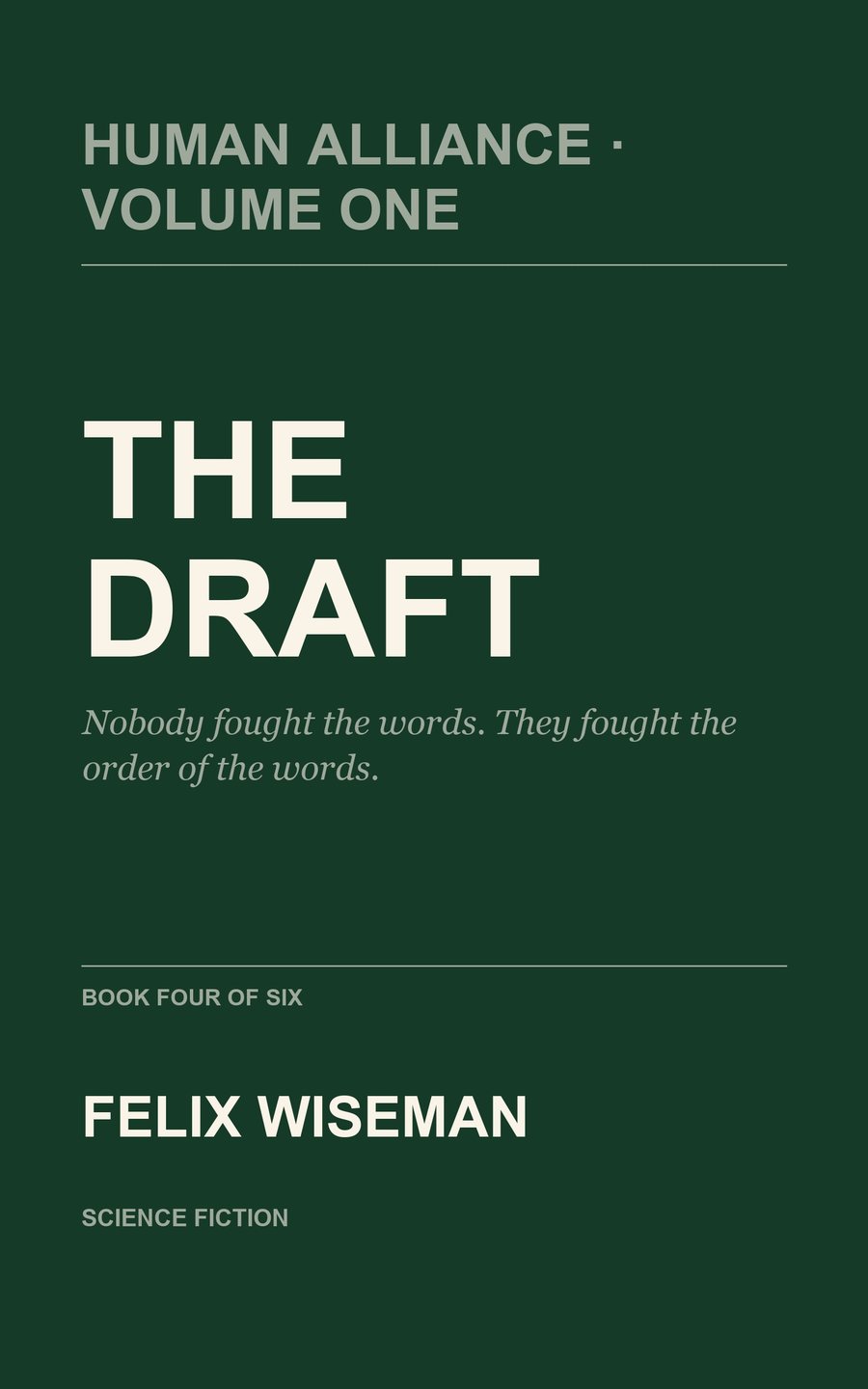
Nobody fought the words. They fought the order of the words.

· Human Alliance, book 4 · Science Fiction

Nobody argued about the words. They argued about the order of the words. It cost eight hundred and twenty-three thousand lives.

Read the full descriptionShow less

By 2035 the instruments work. Water crosses boundaries, ports clear cargo in a common unit, a famine gets a derogation. What does not exist is a government - because a hundred specific authorities are not one authority, and the thing that decides when two of them disagree has to be written down.

The moment it is written down, two hundred and six states have something to refuse.

Asha Varghese writes article 11 in a hotel room in Montevideo in four hours: a definition of sovereignty that can be falsified, with a fourth limb that tests observed conduct rather than powers. It is the only thing she will ever write that outlives her. Nobody proposes a single word of change to it.

They attack the commencement provision instead - three lines of machinery nobody had thought about for more than an hour.

Every argument for delay is technically correct. Every person making it is honest. And because Asha annexed the nine equality measures to article 11 for reasons of drafting elegance, the measures go where the article goes: to the eleventh year.

So she does the only thing left. She makes the constitution state its own price - an appendix, four columns and eight rows, with the last column headed attributable to the transition schedule. It goes through without a vote against, and she does not understand why for years.

A novel about how good documents die, what happens to a person who spends four hundred days in a room with decent people, and the difference between deciding a thing and being unable to say when you decided it.

Still no fleet, still no battle. A drafting committee, a reading group in Kochi that finds the flaw four months before the professionals, a Norwegian negotiator who spends her career on eighteen months of schedule, and a table of numbers that somebody has to read aloud once a year for eleven years.

Book Four of six. Human Alliance, Volume One.

£7.99 · 72pp View book Free sample

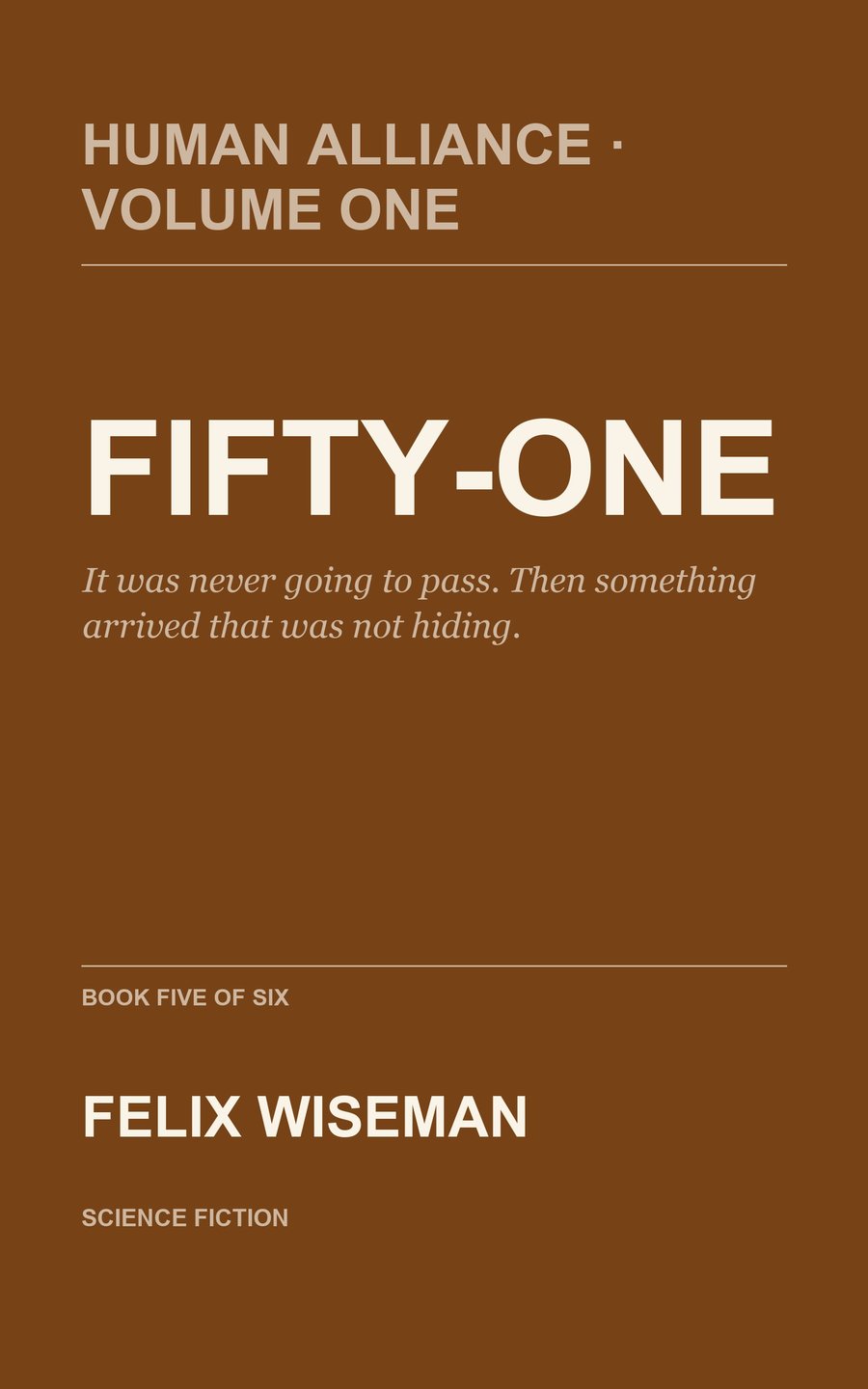
It was never going to pass. Then something arrived that was not hiding.

· Human Alliance, book 5 · Science Fiction

The constitution was never going to pass. Then eleven objects appeared in the outer system and made no attempt whatever to hide.

Read the full descriptionShow less

In June 2038 the count is seventy-one states for and a hundred and four needed, and the modelling says 2047. Everybody supports the instrument. Nobody wants to be among the first to sign an agreement they can never leave.

At 04:11 on Friday the thirteenth of August, eleven observatories on the night side of the Earth record the same thing at the same moment.

The Aperture proved they can be invisible. This is a decision.

Asha Varghese spends the following eleven weeks arguing, in public and increasingly alone, that the species must not adopt its constitution because a fleet is coming - that we would be passing the examination by cheating on the only question ever asked. She loses the argument comprehensively. She is also right, and the arithmetic is in the register, and she has never stopped believing both.

It passes on the eleventh of October 2038 by fifty-one per cent to forty-nine.

And then, with a bare majority for the most irreversible act in human history and four hundred and forty-six people in the chamber who believe they have been steamrollered, a member of the losing side stands up and asks for the votes to be counted a third time on no procedural ground at all - because he wants to be able to tell his neighbours that he asked, and the answer was yes.

The expensive part of legitimacy is doing the unnecessary thing in front of the people who think it is necessary.

The fleet arrives at 11:04 on the twenty-ninth of October. What it does first is the most courteous act in this entire history, and nobody in the chamber expected it, and it takes ninety seconds for anyone to understand what they are looking at.

Book Five of six. Human Alliance, Volume One.

£7.99 · 81pp View book Free sample

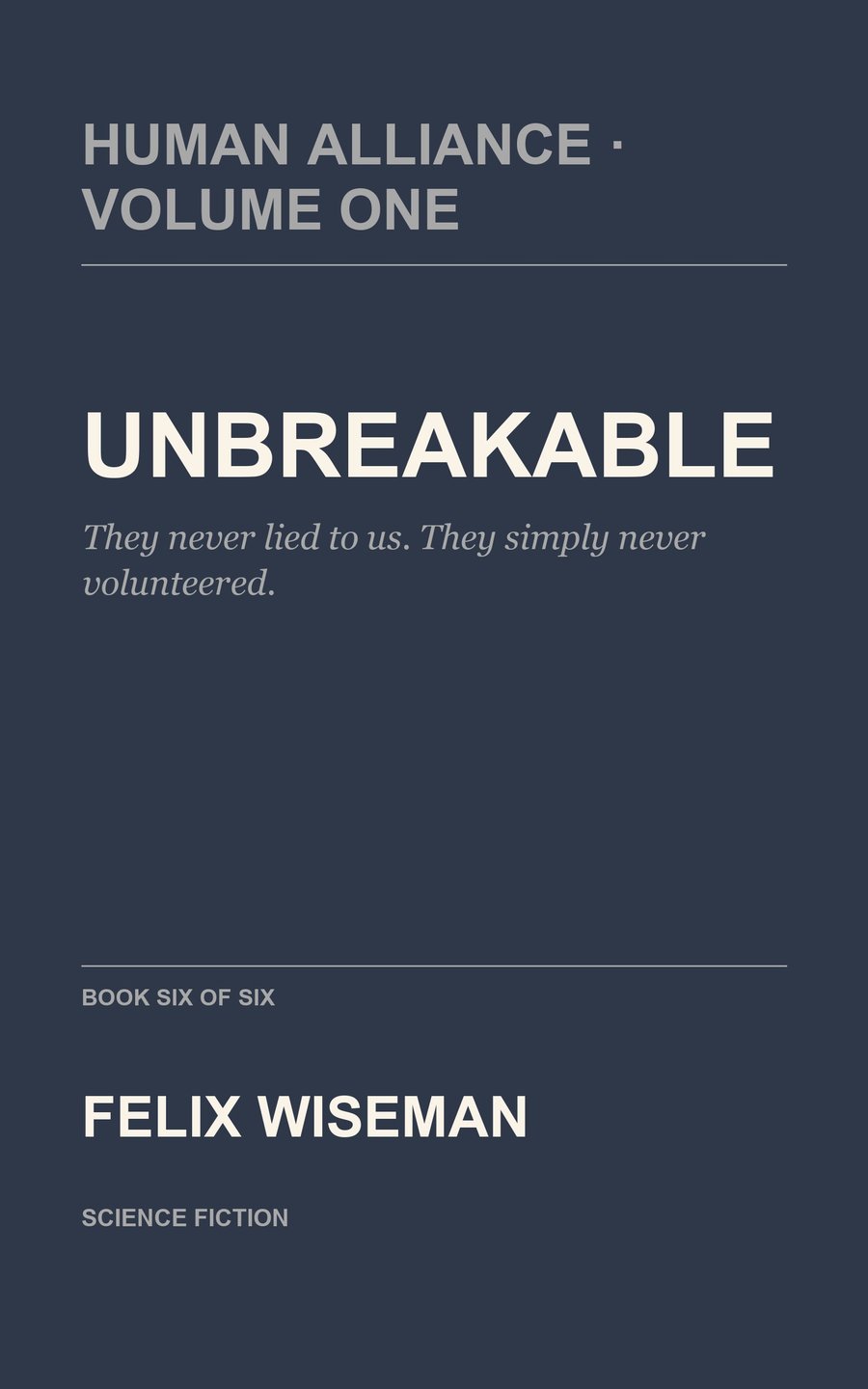
They never lied to us. They simply never volunteered.

· Human Alliance, book 6 · Science Fiction

They never lied to us. In eight and a half years, not once. They simply never volunteered anything, and nobody thought to ask what the Alliance was for.

Read the full descriptionShow less

Humanity has met the condition. The Lasan confirm the nine measures without amending a single figure and add three words that will frighten Asha Varghese for the rest of her life: that is early.

Then they ask their question. Membership is unlimited technology at no cost, for ever, with no obligation to request anything - and it cannot be left, cannot be revoked, and cannot be ceased.

There is one region in their own roll they will not discuss. Six or seven positions where the markers stop and resume. It was asked about in 2030 and met with eleven seconds of silence.

We will not answer this outside the Alliance.

So the species is asked to enter an irrevocable arrangement in order to be told the thing that would tell it whether to enter. It enters. Eleven days later it is told, in nine thousand words, and the answer is not a trick and was never concealed - it was withheld for a reason that turns the entire eight and a half years into something that had been run on us, honestly, in plain sight.

The Alliance is an agreement among species that none of us will cease alone.

The final book of Volume One. The purpose of the Lasan Alliance is disclosed, the Tirani are named, and a fisheries inspector from Ambon who read a document in a reading group asks the question that nobody in the room had the standing to ask.

It ends where it began: a woman of seventy-five in Bengaluru, an item in a queue, a plain in Ladakh, and the finding that there was never a right person and there has never once been one.

Book Six of six, and the close of Human Alliance, Volume One. The war it discloses is Volume Two.

£7.99 · 72pp View book Free sample

She has two hundred and three days, nineteen doses, and one president to keep alive

· Thriller

She has two hundred and three days, nineteen doses, and one president to keep alive.

Read the full descriptionShow less

Mira Kovač arrives naked in an Ontario wood at four in the morning on the fourteenth of May, 2029, eleven days later than the people who sent her intended. Nothing crosses with her. No clothes, no weapon, no documents, no proof that she was born in 2040 in a country that will one day be a republic with a president.

What she has is a body built to run at twenty-eight kilometres an hour, a drug grown into a pocket under her ribs that will keep that body from killing itself, and an instruction: keep the president alive until the third of December.

She knows how it goes. She has memorised the record. Five attempts on Étienne Rousseau's life, four of them failures, and the fifth one the reason a machine gets built that will one day remove her sister from the record of her own country — every document, every photograph, every registry line, until the people who loved her keep the memory and lose the proof.

What she does not know is why the record is wrong about almost everything that matters.

A thriller about the argument, not the chase

Mira is not the only person in 2029 who came from somewhere else. Teodor Vane has been here since 2027. He is seventy, he is dying, he has spent twenty years and eleven lives trying to stop the machine from ever existing — and the case he makes is the one she cannot answer.

Because her side keeps records, which means her side can be proved wrong in a court. And his side keeps none, which means nobody will ever be able to prove anything about the Undertow at all.

Fifty-one per cent against forty-nine. She is on the right side of it by about one per cent, and the book never pretends the margin is wider than that.

What you get

• A one-way time traveller with no gadgets, no backup and no way home — only a failing body and a date • An antagonist who is right about almost everything and is never secretly venal • A police inspector who cannot be told the truth and works it out anyway • A president who is not a symbol: a constitutional lawyer with a bad knee, a terminal diagnosis, and a signature four months from being worth more than his life • A body count that is counted — every death has a name, an age, and a line in a notebook that looks like accounts • A resolution that turns on a demonstration in front of four journalists, not on who shoots first

Super Agent Mira is a complete standalone novel of roughly 51,000 words, set in an alternate near future. It is a thriller for readers who want the moral argument to be as sharp as the action, in the tradition of the spy novel that is really about institutions.

A note on what this book is not

There are no gadgets and there is no way back. The technology is fixed, small and cruel: one direction, nothing crosses, an eleven-day error at forty-two years, and a drug that runs out. Nobody in this book saves everybody. The nurse who dies in chapter twenty-eight stays dead, and three chapters are spent on that, and if you want a thriller where the cost is announced and then quietly waived, this is not it.

Canada in these pages is a republic with a president. In the world you live in, it is a constitutional monarchy with a prime minister. Every institution, official and event in the book is invented.

£6.99 · 179pp View book Free sample

Cressida Joan Fairlie 5 books

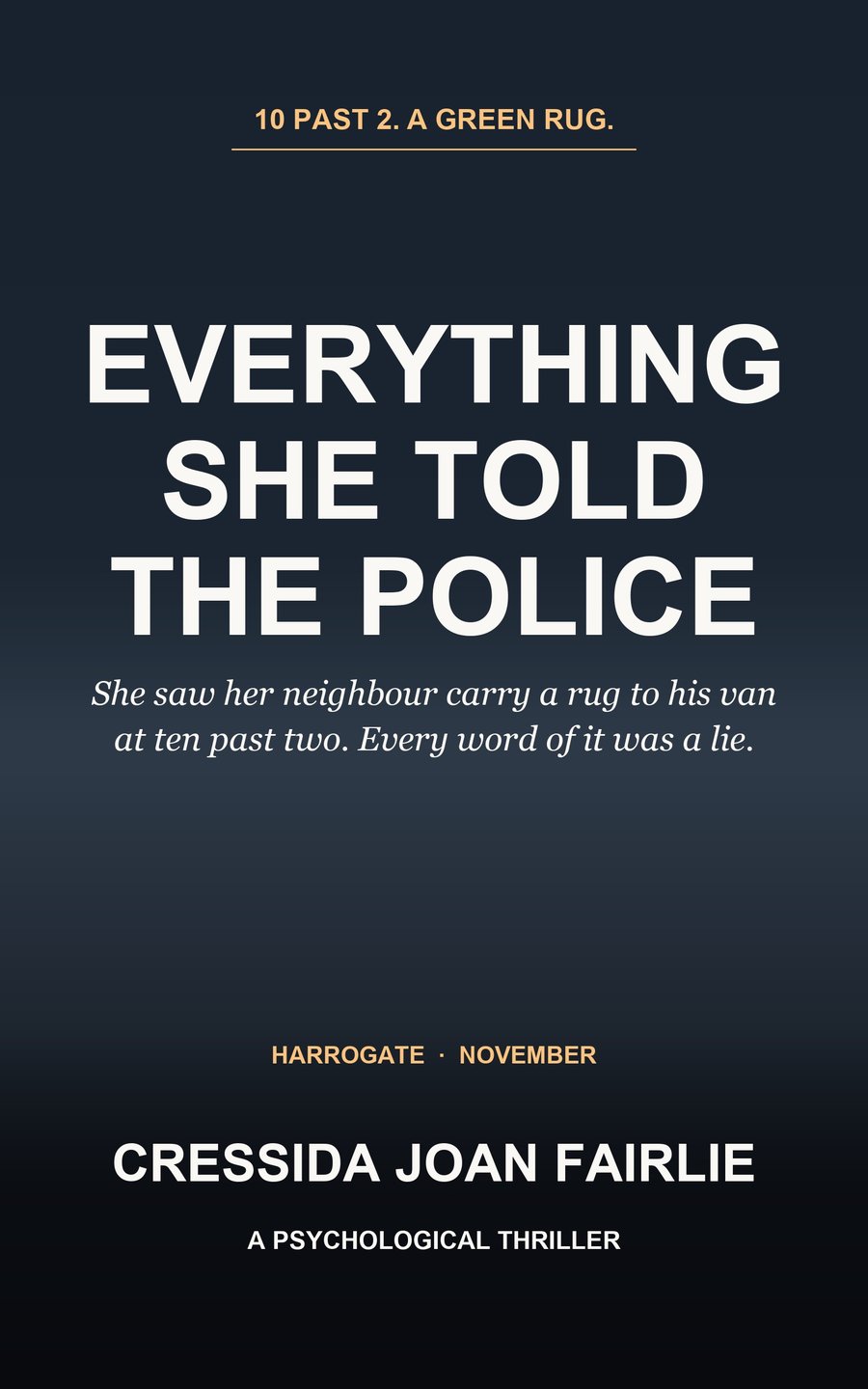
She saw her neighbour carry a rug to his van at ten past two. Every word of it was a lie.

· Thriller

Hannah Price doesn't sleep. So when her friend Leah vanishes from the house across the Close on Bonfire Night, Hannah is the perfect witness. From her landing window she saw Leah's husband Adam carry a rolled green rug out to his van in the middle of the night, and drive away. She tells the police the time on the landing clock. She tells them the fringe was swinging under the street light.

Read the full descriptionShow less

Adam swears he never left the house. Then the rug turns up in a skip on the moor, with Leah's blood on it.

There's just one problem. Hannah wasn't at the window.

Everything she told the police was true, except the part that mattered. And the longer Adam sits in a prison cell waiting for a trial, the more Hannah starts to wonder who she was really protecting.

Everything She Told the Police is a twisty domestic thriller told by three people: the witness, the husband and the one person nobody is looking for.

• Short chapters, three narrators, and a twist you can go back and find the clues for. • A domestic thriller with no sexual content and no violence on the page. The danger is in what people believe. • Set in present-day Harrogate over one November.

Perfect for readers of Freida McFadden, Lisa Jewell and Claire Douglas.

£4.99 · 139pp View book Free sample

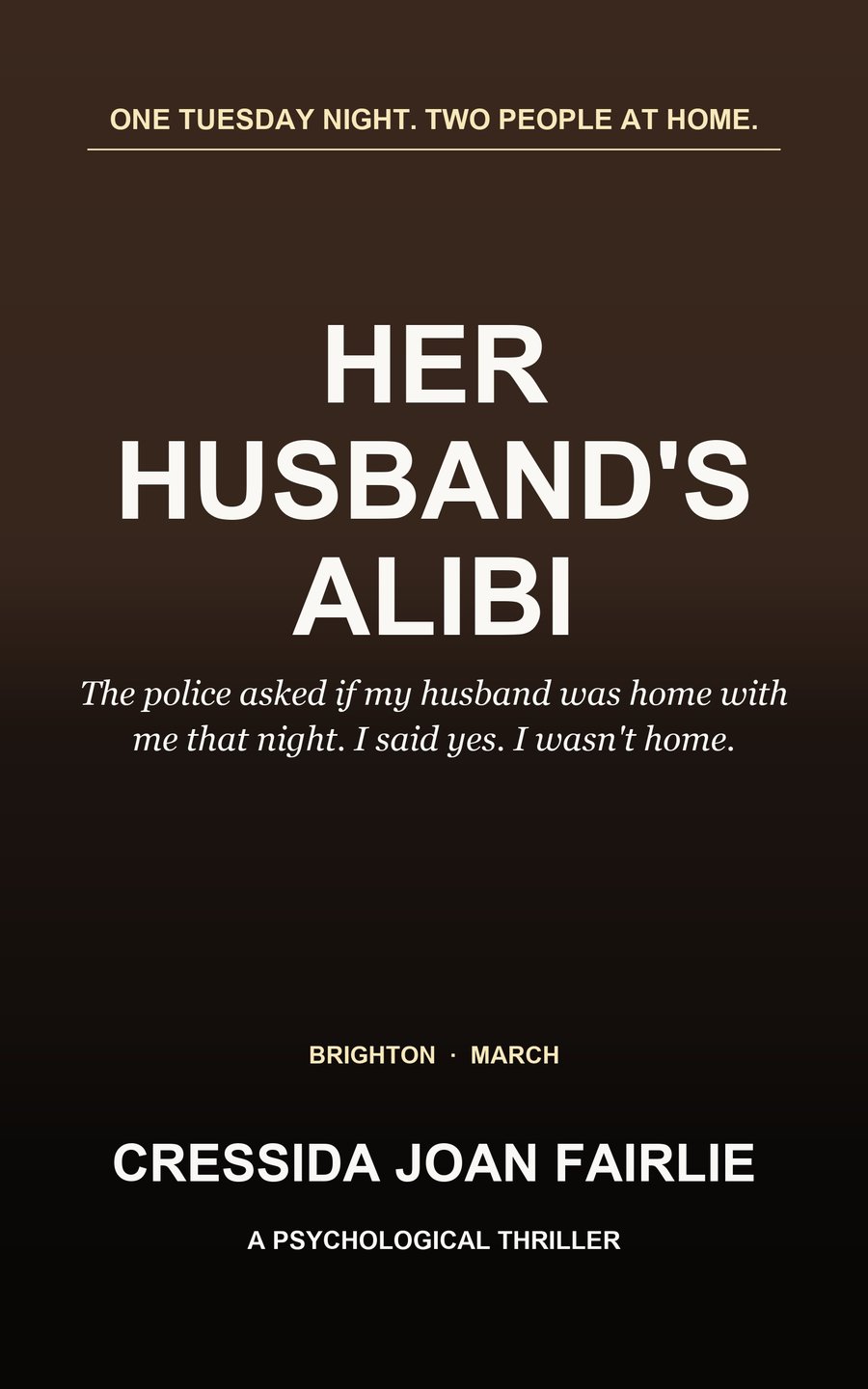
The police asked if my husband was home with me that night. I said yes. I wasn't home.

· Thriller

On a Thursday morning in March, two detectives come to Georgie Selby's door in Hove. Frankie Carver, her husband's business partner, has been found dead at the foot of the stairs in her Kemptown flat. Jude Selby says he was at home with his wife all Tuesday night. Can Georgie confirm that?

Read the full descriptionShow less

She says yes.

She knows about the affair. She knows about the message Frankie sent Jude that night: Tell her tonight or I will. She knows the police are looking hard at her husband. And she knows the one thing nobody else does: on Tuesday night, between twenty to eleven and twenty past midnight, she wasn't at home.

DS Nasreen Qureshi of the Major Crime Team doesn't believe either of them. She has a woman in a yellow raincoat on a seafront camera, a second wine glass on the victim's table, and a husband who keeps saying we were both at home before anyone has asked about his wife.

The longer Georgie keeps her husband's alibi, the more it looks like her own. And she has started to wonder why, in five weeks, Jude has never once asked her where she was.

• A twisty domestic thriller told by a wife, a detective and, at the very end, a husband. • Set in present-day Brighton and Hove. • A standalone novel.

£4.99 · 145pp View book Free sample
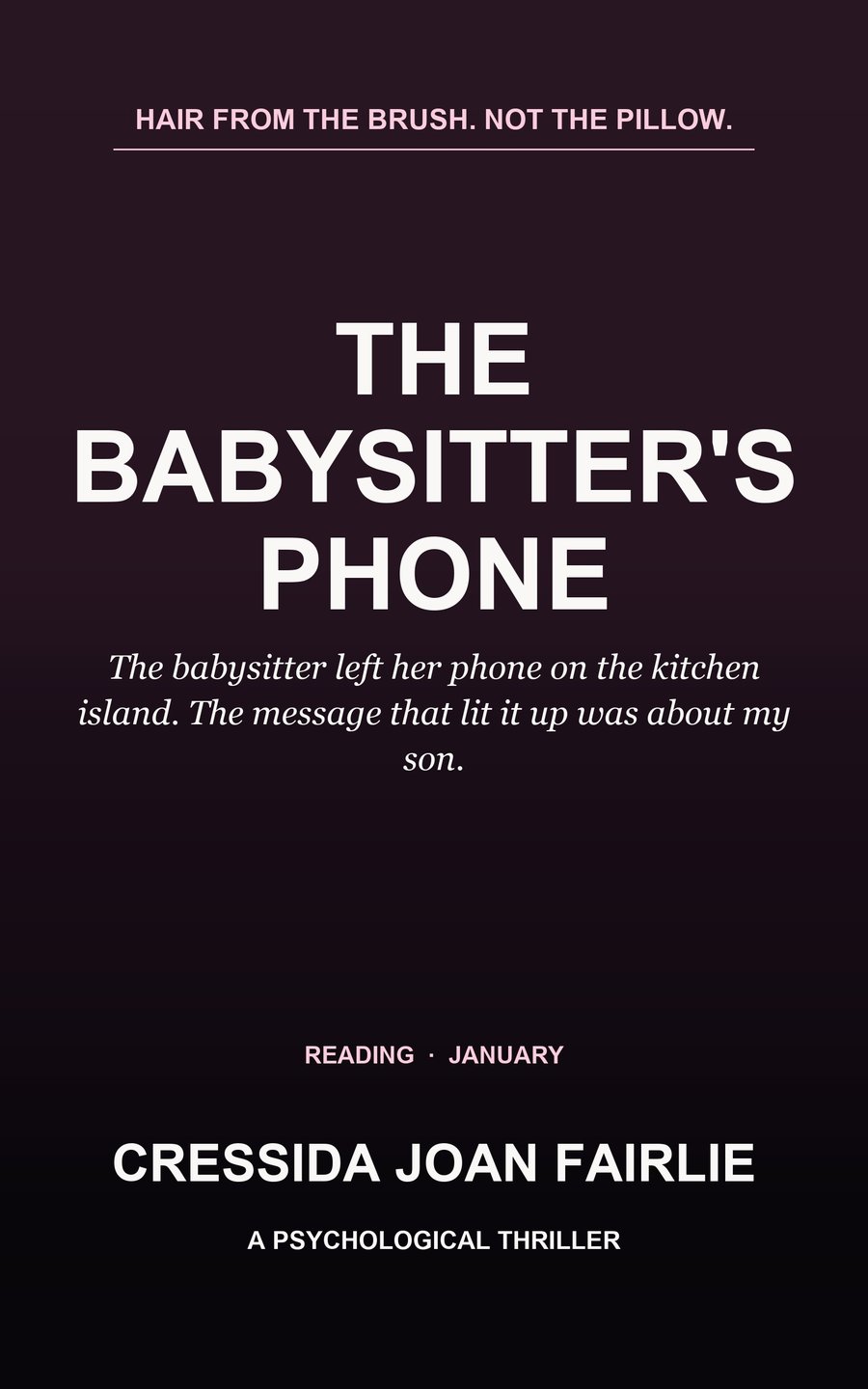
The babysitter left her phone on the kitchen island. The message that lit it up was about my son.

· Thriller

Sophie Marchant's babysitter is seventeen, takes her shoes off at the door, and is the only person her three-year-old son Arlo will let do the Gruffalo voices. Then, one Friday night in January, Maisie leaves her phone behind, and a message from her mother lights up the screen.

Read the full descriptionShow less

Upstairs, Arlo's hairbrush is clean. It's never clean on a Friday.

The babysitter's mother cuts hair on Church Street. Sophie's husband has been sitting in her chair since October. A child's toothbrush vanishes from a locked house. And when the police warn the woman off, she asks them to pass on one thing: a date. The nineteenth of January, 2023.

It is a date Sophie has spent four years trying not to remember.

The Babysitter's Phone is a twisty domestic thriller told by three women: the mother with a secret, the teenager who stole for hers, and the one person who has been grieving all along.

• Short chapters, three narrators, and more than one twist you can go back and find the clues for. • No sexual content and no violence on the page. The danger is in what a family will do to keep a child. • Set in present-day Reading over one January and February.

Perfect for readers of Freida McFadden, Lisa Jewell and Claire Douglas.

£4.99 · 147pp View book Free sample
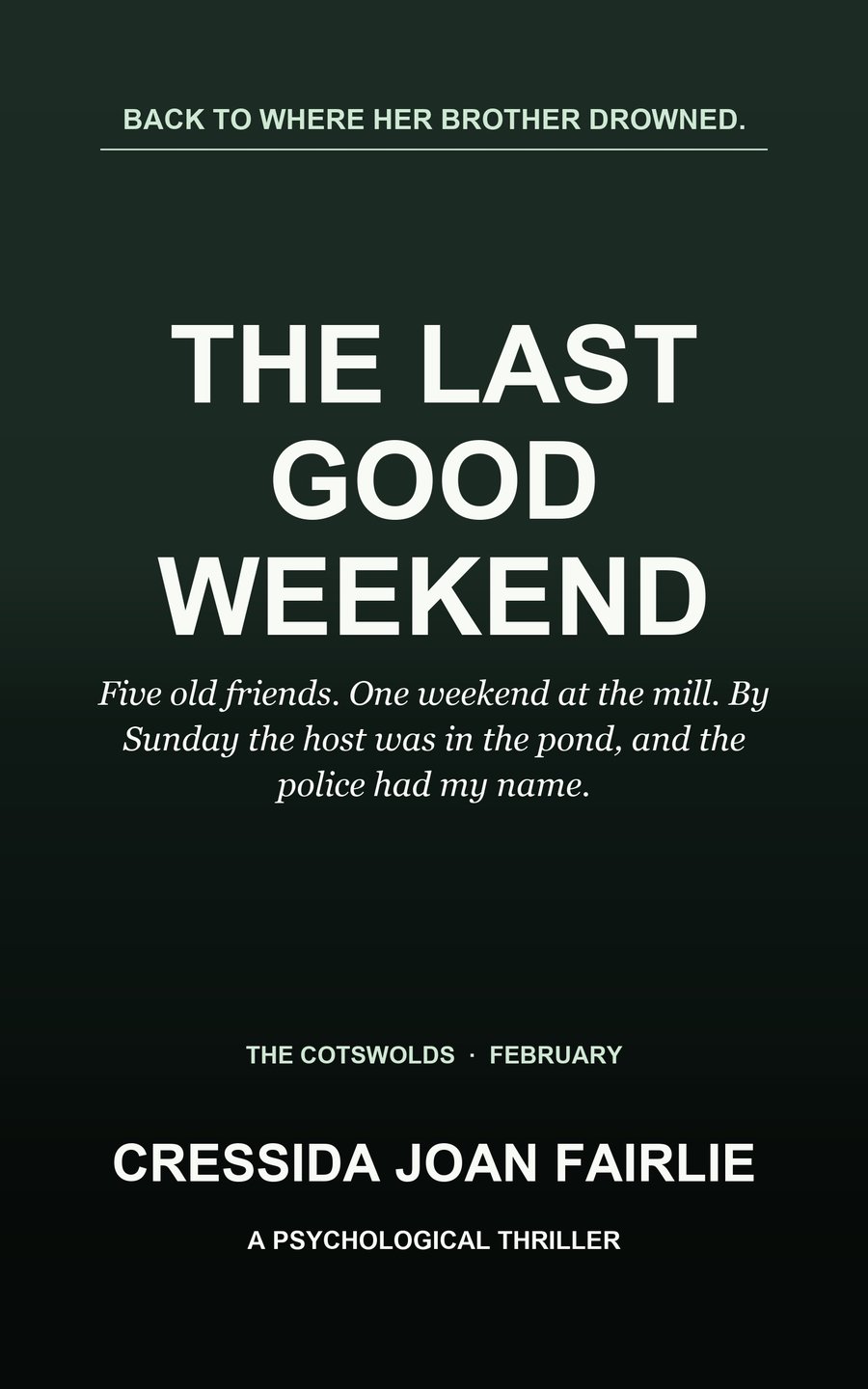
Five old friends. One weekend at the mill. By Sunday the host was in the pond, and the police had my name.

· Thriller

Twenty years after they left sixth form, Tavy Rathbone invites the old friends back to Millbrook, the Cotswold mill where her little brother drowned on the night of their leavers' party. Naomi Aske nearly doesn't go. She's a GP with a ten-year-old son and no spare weekends, and she has never known why Tavy stopped speaking to her the summer Laurie died.

Read the full descriptionShow less

But Tavy's face has changed. She isn't drinking. She wants everyone there. And she wants to know, once and for all, who went down to the water with him that night.

By Sunday morning Tavy is in the millpond. A thread of Naomi's green scarf is caught on the sluice. An email Tavy sent at three in the morning names her. And Tavy had written to the police in January to accuse her.

Only one of the old friends seems to be on Naomi's side: Lydia, the barrister, who always knows exactly what to say. Then a solicitor in a bow tie delivers a letter, addressed to Lydia, in a dead woman's handwriting.

It begins: You're going to burn this.

The Last Good Weekend is a twisty domestic thriller told by two women who were once best friends, and by the one who planned it all.

• Short chapters, three narrators, and a twist you can go back and find every clue for. • No sexual content and no violence on the page. The danger is in what old friends will stay silent about. • Set in the present-day Cotswolds, Stroud and Bristol over one February and March.

Perfect for readers of Lucy Foley, Lisa Jewell and Claire Douglas.

£4.99 · 163pp View book Free sample
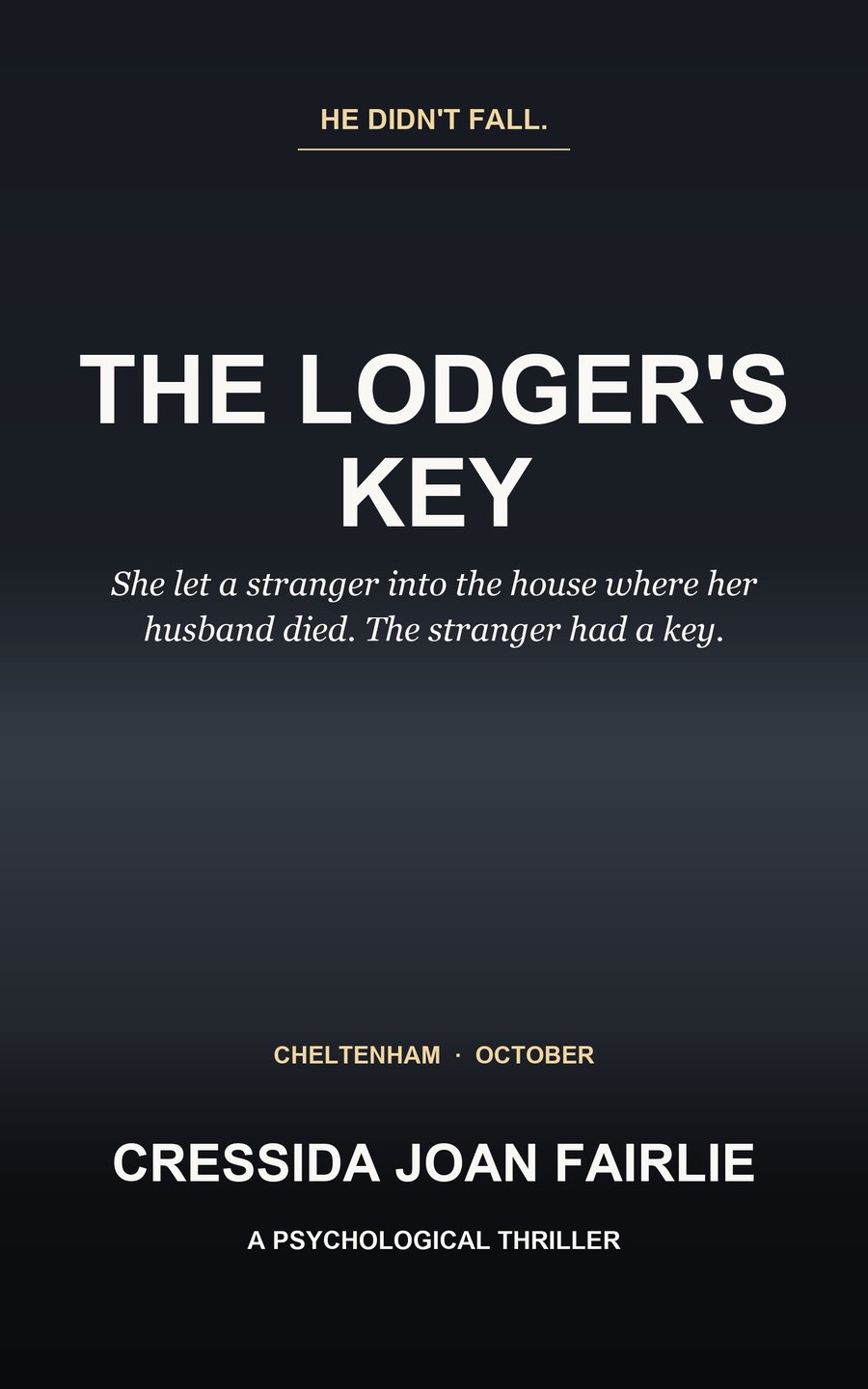
She let a stranger into the house where her husband died. The stranger had a key.

· Thriller

All summer, the notes have come through Claire Hatherley's letterbox. Three words, printed, no name. Five of them by October — and now she needs the money, so she lets the top room of her tall Cheltenham townhouse to a quiet young woman called Ivy.

Read the full descriptionShow less

It is the house where Claire's first husband fell to his death fifteen years ago. On the first afternoon, Claire sees the old brass key on her lodger's keyring. It is the key that vanished the night he died.

Ivy has come to prove Claire killed him. Claire has been lying about that night for fifteen years. And neither of them knows the truth — because the one person in the house who does has been waiting all summer for somebody brave enough to find it.

The Lodger's Key is a twisty domestic thriller about a staircase, a lie, a missing phone and a key that fits a door it shouldn't — told by two women who each think they know what happened in the house on Albemarle Terrace.

• Two narrators, short chapters, and a twist you can go back and find the clues for. • A domestic thriller with no sexual content and very little violence on the page — the danger is in the house. • Set in present-day Cheltenham over one October.

Perfect for readers of Freida McFadden, Alice Feeney and Lisa Jewell.

£4.99 · 150pp View book Free sample
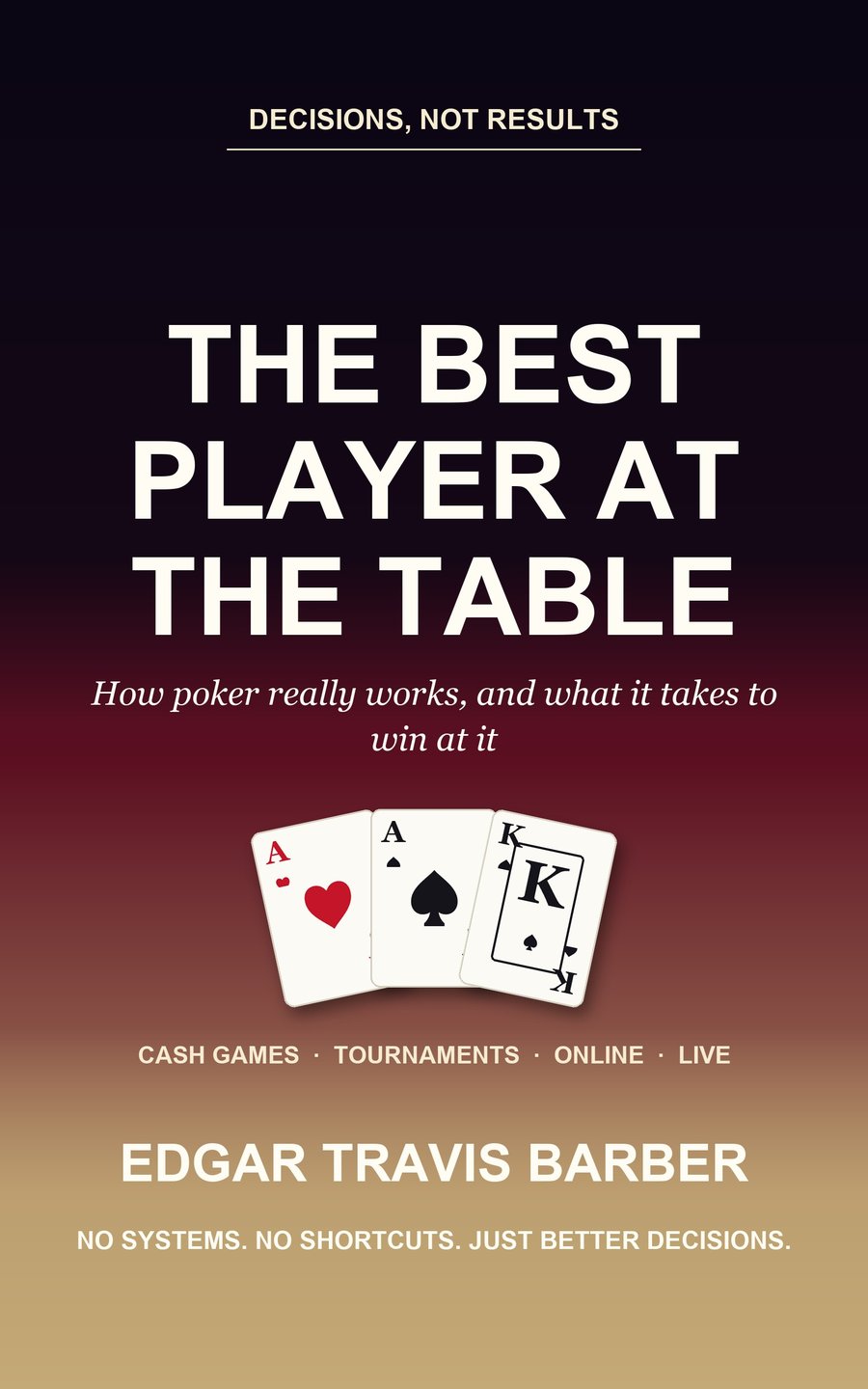
Edgar Travis Barber 1 book

How poker really works, and what it takes to win at it

· Poker & Games

The cards decide a hand. Your decisions decide a thousand.

Read the full descriptionShow less

Two aces all in against two kings win 82.36% of the time. About 17 times in a hundred, the player with the aces loses the pot and has still played perfectly. Understanding that difference, between a good decision and a good result, is where becoming a strong poker player begins, and it is the thread running through The Best Player at the Table.

This is a plain-spoken guide to no-limit Texas hold'em, in cash games and tournaments, live and online. Every probability in it was calculated by counting every possible card, every study can be looked up, and every example is worked out so you can check it.

The foundations

• You are playing the people, not the house. Why being better than your opponents is not enough, and what the rake really costs a table. • The numbers you need. Starting hands, flops, outs and the rule of four and two, checked against the exact figures. • Pot odds and expected value, worked in full, so every call becomes a question with an answer. • Position, starting hands and ranges, with a cautious starting table by seat and what the famous all-in contests are really worth.

Playing well

• Betting with a purpose: value bets, bluffs, semi-bluffs and sizing. • Reading the board and narrowing a range, street by street, including blockers. • What research on 27 million online hands found about who wins, and what a study of professional players found about tells. • What the computer programs that beat top professionals taught everyone else, and why copying them is only half the answer. • Tournaments: stack sizes, and why chips are not money near the prizes.

The part away from the cards

• Why a genuinely winning player can still be behind after 10,000 hands, and what that means for your bankroll. • What tilt looks like from the inside, and what elite professionals do differently. • How strong players study: records, hand reviews and honest self-assessment. • Where online poker is legal in the United States, Great Britain and Ontario, as of 2026. • A plan for your next year at the table, plus reference tables and a session record sheet.

Three hard stops: play only where it is legal and you are old enough; there is no system that guarantees a profit; and if poker is costing you more than you can afford, help is free. The book gives helplines for the UK, the United States and Ontario.

This book contains no secret system and no promise of easy money. As a group, players lose money over time, and the book says so. The author is not a professional player and does not pretend to be. If you want to understand the game well enough to make better decisions than the people around you, and to judge yourself honestly, start here.

£6.99 · 102pp View book Free sample
Hester Maud Trevellick 5 books

The parish council chair drank her tea. The village crossword setter read the clue she left behind.

· The Midge Alderton Mysteries, book 1 · Mystery

Top of the milk? Treasurer's been at it for years (8)

Read the full descriptionShow less

Marjorie "Midge" Alderton is seventy-nine, a retired village postmistress, and — though almost nobody in Wexham Staithe knows it — the setter of the Saturday cryptic crossword in the local paper.

At the village's Macmillan coffee morning, the formidable chair of the parish council stirs a spoon of honey into her peppermint tea and says it has a bite to it. Within the hour she has collapsed. By teatime she is dead. And in her handbag, addressed to Midge's secret crossword name, is a torn notebook page: one clue, and a request to check my working.

Somebody in Wexham Staithe has been at it for years. With her lodger the new village GP, her greyhound Biscuit (terrified of pigeons), and a detective sergeant she once sold sherbet lemons to, Midge sets out to solve the last clue a clever woman ever wrote — one handwriting, one flower bed and one coffee morning at a time.

• A clean, cosy, fair-play mystery: every clue is on the page before the reveal. • Set in present-day north Norfolk — saltmarsh, tide tables, a village hall and a great deal of cake. • Book one of the Midge Alderton Mysteries.

Perfect for readers of Richard Osman, M.C. Beaton and Agatha Christie.

£4.99 · 160pp View book Free sample
The cake judge meant to tell the truth at four o'clock. At half past twelve she was dead.

· The Midge Alderton Mysteries, book 2 · Mystery

A parcel turns up behind the water tank in the village hall loft, postmarked Wexham Staithe, December 1998, and addressed to the cake judge of the Winter Show. Midge Alderton, seventy-nine, retired postmistress and secret setter of the Saturday cryptic crossword, knows the initials beside the postmark. They are hers. She took that parcel over her own counter, from a man she was fond of, and failed.

Read the full descriptionShow less

Inside is a letter from Frank Rix, the old hall caretaker, who left the village in disgrace that winter, accused of stealing the prize money. It says the Show's winning Christmas cakes were baked in the judge's own bakery.

The judge is still judging. And on Show day she means to stand up at the prize-giving and tell the whole village the truth. At half past twelve she is found dead at the foot of a loft ladder she could never have climbed, and somebody has moved the winner's rosette.

With her lodger the village GP, her pigeon-fearing greyhound Biscuit, and a detective sergeant who has started coming round for coffee on Saturdays, Midge follows a trail of gold-headed pins, frost on a windscreen, a holly leaf with one berry too many, and a twenty-eight-year-old bank slip, to put right a wrong she should have questioned long ago.

• A clean, cosy, fair-play mystery set in present-day north Norfolk in the run-up to Christmas. • No sex, no swearing, and the death happens off the page. • Book two of the Midge Alderton Mysteries; reads on its own.

£4.99 · 176pp View book Free sample
A peal board says a dead man rang the fourth bell. Forty years later, somebody rang the tenor.

· The Midge Alderton Mysteries, book 3 · Mystery

In the ringing chamber of St Withburga's hangs a peal board for three hours and four minutes of Stedman Triples, rung on 14 March 1987. On the fourth bell, in gold paint, is Walter Brine. Walter was buried four days before it was rung.

Read the full descriptionShow less

Dennis Wragg, tower captain and for thirty-six years the village postman, brings the puzzle to Midge Alderton, seventy-nine, retired postmistress and secret setter of the Saturday cryptic crossword, who remembers that afternoon because the bells were ringing for her fortieth birthday. Dennis means to find out who really rang the fourth, and to give that man the chance to explain himself.

A week later, on a still Saturday night, Midge hears somebody raise the tenor bell, evenly and beautifully, in four minutes flat. In the morning Dennis is found dead beneath its rope, and it looks like an accident. But Dennis couldn't raise that bell any more, and there is almost nobody in the village who could.

With her lodger the village GP, who has just taken up ringing, her pigeon-fearing greyhound Biscuit, and a detective sergeant who comes round for lemon cake on Saturdays, Midge follows a barking spaniel, a church clock that loses four minutes a week, a sympathy card with crossed sevens, and a purple and gold bell rope back to a quay in the dark in 1987.

• A clean, cosy, fair-play mystery set in present-day north Norfolk in a February of frost and bells. • No sex, no swearing, and the death happens off the page. • Book three of the Midge Alderton Mysteries; reads on its own.

£4.99 · 183pp View book Free sample
The man who knew every creek on Stiffkey marsh was caught by the tide. Midge Alderton wants to see his tide table.

· The Midge Alderton Mysteries, book 4 · Mystery

Gideon Pryke has walked the north Norfolk saltmarsh for twenty years and never lost a walker, a dog or a boot. He has one rule: off the marsh four hours before high water. Not three and a half. So when somebody posts him four anonymous tide tables with one Saturday ringed in red, he brings them to Midge Alderton, eighty, retired postmistress and secret setter of the Saturday cryptic crossword.

Read the full descriptionShow less

The envelopes turn out to be a kindness from somebody who can hardly write. But Gideon is building a case of his own, about a famous rare bird, a television naturalist and a record his late father never believed. He promises to tell Midge all about it after the committee meets.

On a Friday evening in April, the day after he read Midge his high tide from his own little booklet, Gideon goes out alone to mend a plank across Garnet Creek, and the sea comes in behind him. Everybody says the marsh took him. Midge remembers the time he read out, and does the sum.

With her lodger the village GP, her pigeon-fearing greyhound Biscuit and a detective sergeant who would like one quiet spring, Midge follows a page with no ticks on it, a heap of coats at a bird-club talk, a pale patch of mud in a famous photograph, and a pencil note she wrote in the margin of a post-office ledger twenty-nine years ago.

• A clean, cosy, fair-play mystery set on the present-day north Norfolk coast in an April of spring tides. • No sex, no swearing, and the death happens off the page. • Book four of the Midge Alderton Mysteries; reads on its own.

£4.99 · 143pp View book Free sample
Father Christmas died in his grotto before the raffle draw. Midge Alderton wants to see the stamp on the winning ticket.

· The Midge Alderton Mysteries, book 5 · Mystery

In May, five Christmas cards arrive on Clifford Pegg's doormat, one every Monday, addressed in capitals his late wife taught. The village Father Christmas of twenty-two years gives up the grotto. Midge Alderton, eighty, retired postmistress and secret setter of the Saturday cryptic crossword, knows exactly where a letter waits: on a doormat in a shut shop.

Read the full descriptionShow less

So this year there is a new Father Christmas. Max Tovell is a careful retired bank manager and the fair's new treasurer, and he has been counting fifteen years of raffle stubs. Each one carries Midge's old post office date stamp. The money doesn't add up, and four prize winners don't seem to exist.

On the day of the Christmas fair, between one child and the next, Father Christmas takes a nip of mulled wine from his flask and dies in the vicarage chair. Everybody says it was his heart. Midge remembers a dent in a flask, a bay leaf that wasn't, and a winning ticket stamped with three letters where her stamp only ever printed two.

With her lodger the village GP, her greyhound Biscuit and a detective sergeant who would like one quiet Christmas, Midge follows a raffle drum, fifteen years of parish magazines, a wreath the size of a bicycle wheel, and a crossword clue meant for one reader only. It all leads to a brazier in the churchyard on Christmas Eve.

• A clean, cosy, fair-play mystery set in a present-day north Norfolk village from May to Christmas. • No sex, no swearing, and the death happens off the page. • The fifth and final Midge Alderton Mystery; reads on its own.

£4.99 · 162pp View book Free sample
Isolde Mae Carrow 5 books

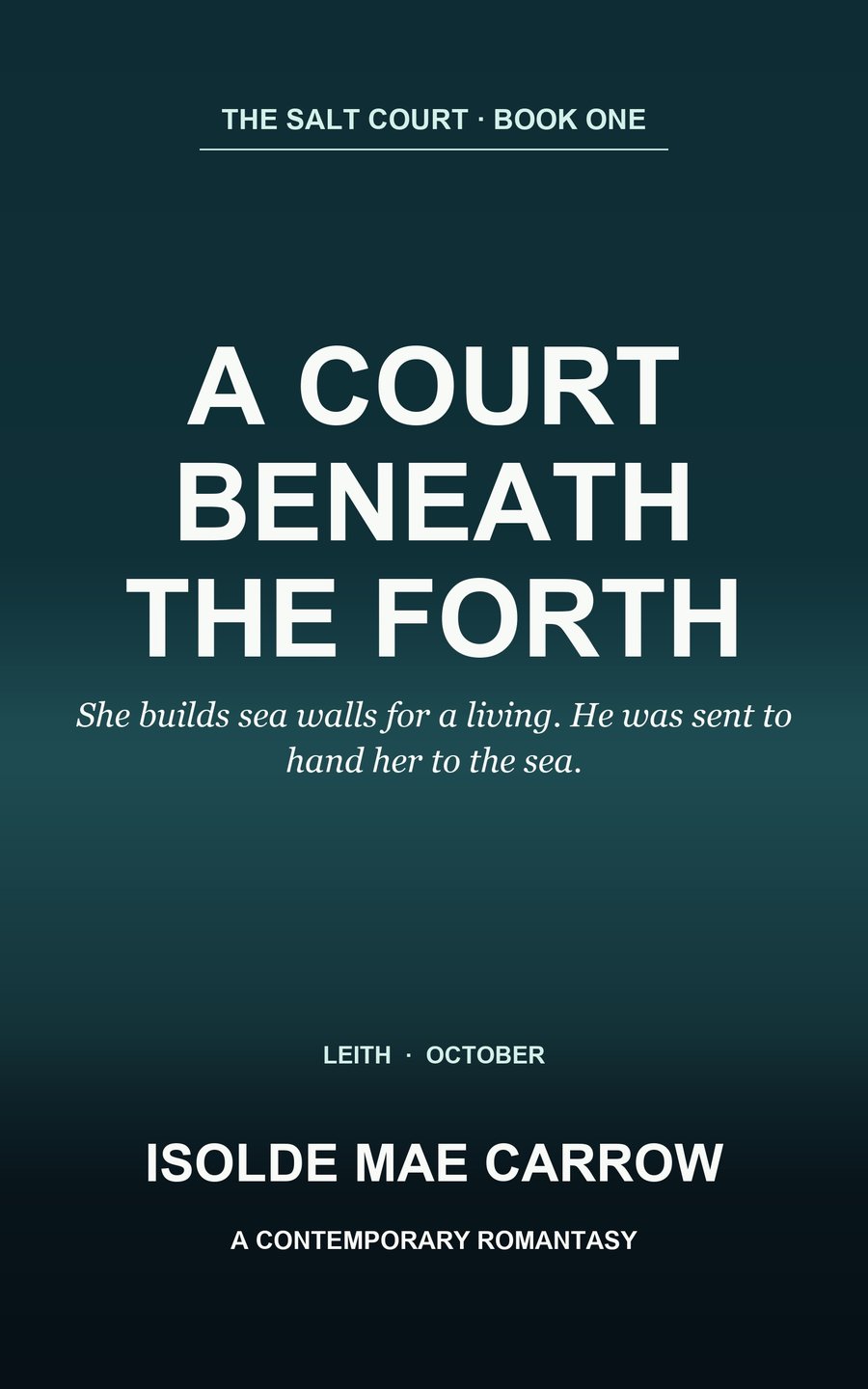
She builds sea walls for a living. He was sent to hand her to the sea.

· The Salt Court, book 1 · Fantasy

A drowned man in her sea-gate. Her missing mother's name on his skin.

Read the full descriptionShow less

Wren Balfour builds flood defences for the City of Edinburgh Council. She has spent twenty-two years keeping the sea out — ever since the summer evening her mother let go of her hand on Portobello beach and walked into the water.

Then a stranger in a ferry jacket comes for the body at low water, and nobody but Wren can see him. Ronan Seil is an engineer on the Granton ferry. He is also two hundred and twelve years old, heir to a court of sea folk hidden under the old harbour wall at Leith — and he cannot tell a lie. So he tells her the truth: he has been ordered to bring her to his queen before the full-moon tide.

The Salt Court is starving. The cold court of the inland lochs is coming down the Water of Leith to take the Forth. And Wren is the price of a promise her mother made before she was born.

She has one October, a flood protection scheme, a best friend in a portakabin — and a man who can only ever tell her what is true.

• A contemporary romantasy set in present-day Edinburgh and Leith — selkies, bargains and a flood on a spring tide. • Two narrators, a slow burn and a love story told by a hero who literally cannot lie. • Sensual, not explicit. Book one of the Salt Court series.

Perfect for readers of Sarah J. Maas, Holly Black and Juliet Marillier.

£4.99 · 152pp View book Free sample

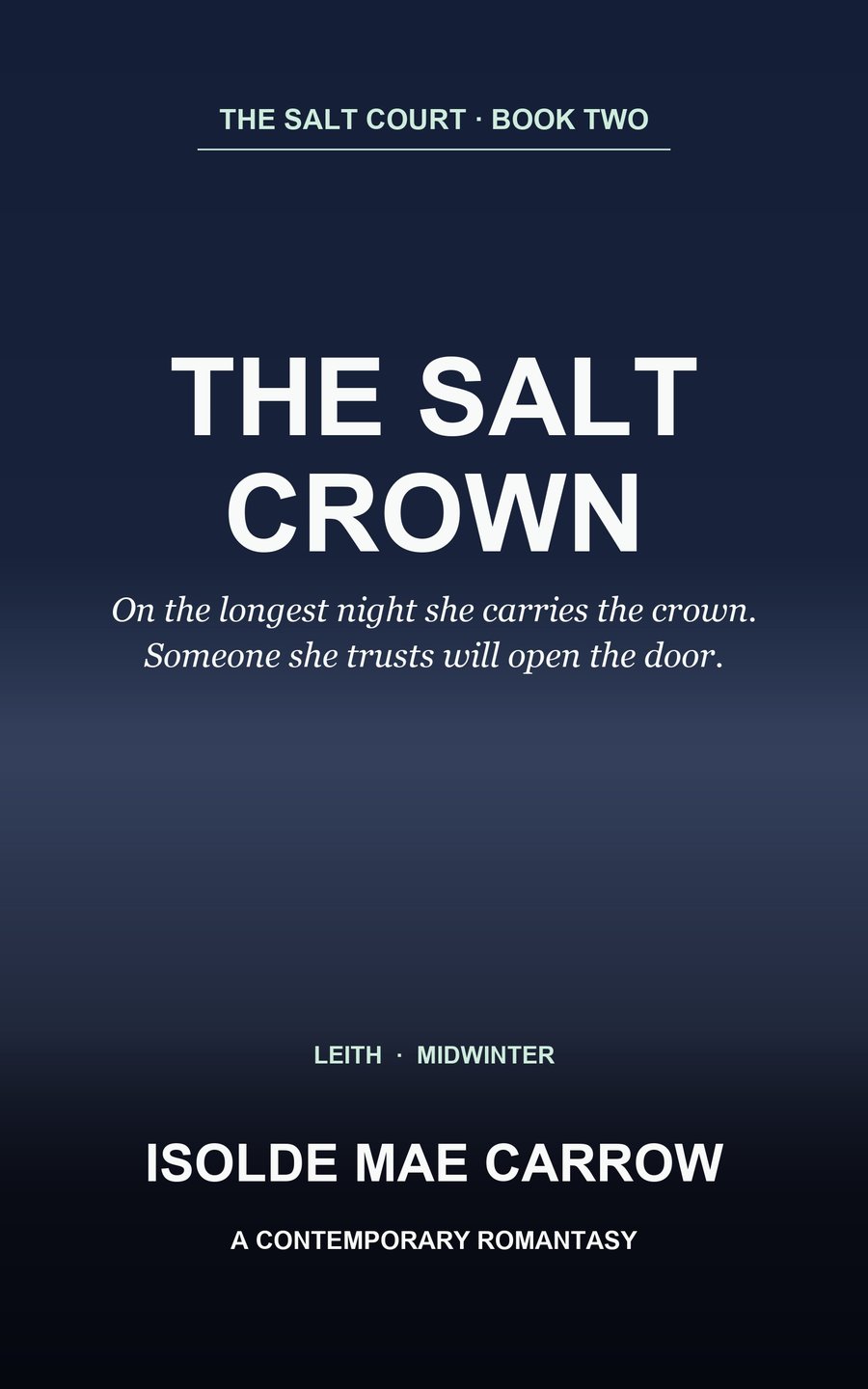
On the longest night she carries the crown. Someone she trusts will open the door.

· The Salt Court, book 2 · Fantasy

Two months after Wren Balfour stopped a flood and saved the Salt Court beneath Leith harbour, Ronan Seil's sister washes up on the slipway at Burntisland, grey from the roots after twenty-two years as a hostage under a Pentland reservoir. She says the Hollow let her go for nothing.

Read the full descriptionShow less

On the longest night of the year Wren is to carry the Salt Crown across the court's hall, as her grandmother did before her, so that the Firth of Forth will say yes to the court for one more year. And Ronan, who cannot lie, suddenly has something he cannot tell her.

Then the lights go out, and the crown is gone.

To hold the Forth together until the full-moon tide, Wren will have to choose the court over the man she loves. She will have to sit in a seat she never wanted. And, on Christmas Eve, she will have to do the one thing she has never managed: put on her own skin and go into the Hollow's water.

• Contemporary romantasy set in present-day Edinburgh and the Pentlands, told by both of them. • Sensual, not explicit. A hero who cannot lie, a promise he cannot break, and a heroine who builds sea walls. • Book two of five. Start with A Court Beneath the Forth.

For readers who love selkie legends, fated bargains and slow-burn love with teeth.

£4.99 · 181pp View book Free sample

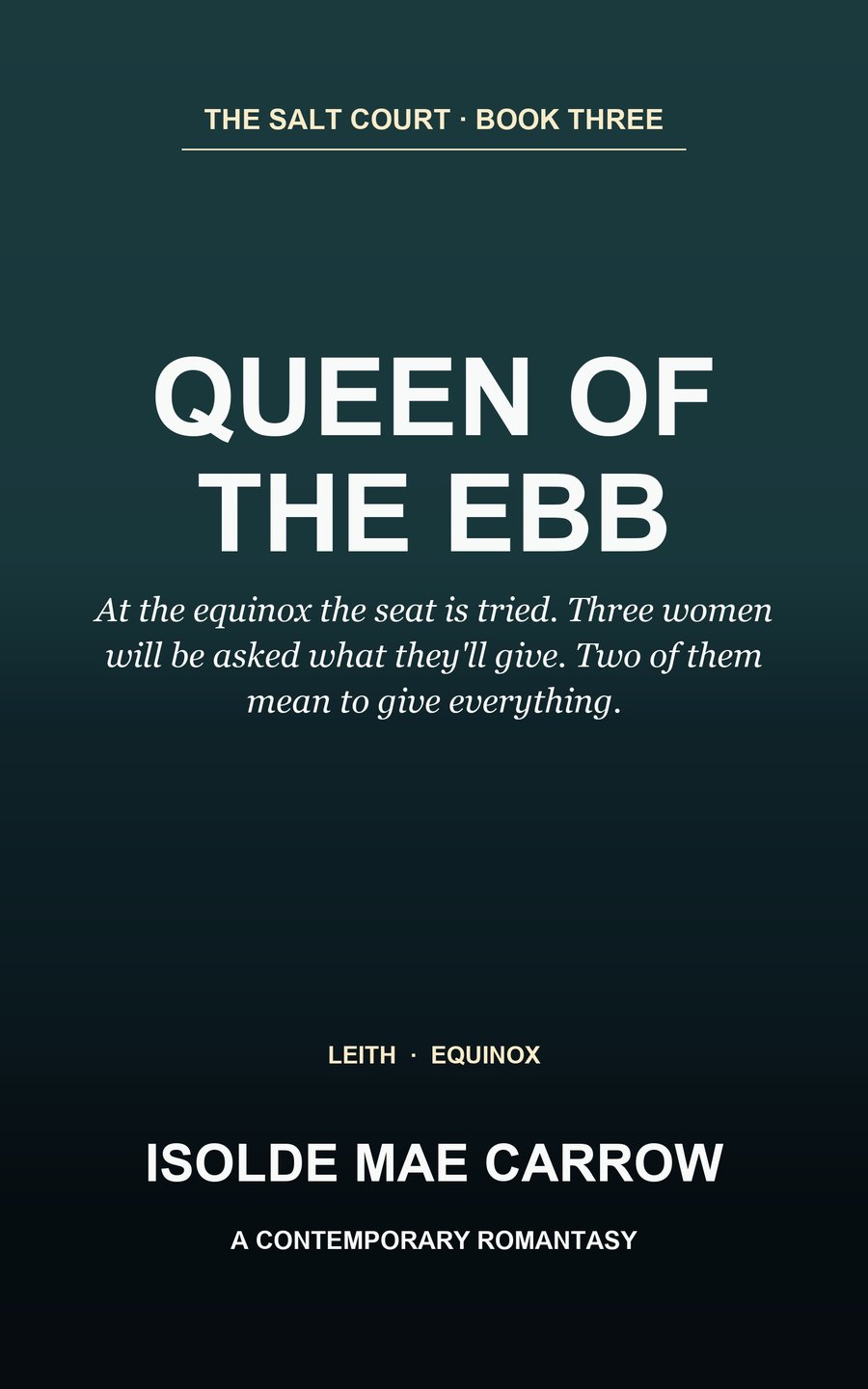
At the equinox the seat is tried. Three women will be asked what they'll give. Two of them mean to give everything.

· The Salt Court, book 3 · Fantasy

Wren Balfour has three weeks until the spring equinox, and the council wants to drive 340 metres of steel along Leith Shore, straight across the door of the Salt Court. The seal folk beneath the harbour cannot touch iron.

Read the full descriptionShow less

Then her mother walks into the fish bar downstairs, twenty-two years after she walked into the sea at Portobello and left a seven-year-old on the sand.

The empty seat under the Shore knows three women now: Morvoren, who has held it too long; Mairi, the true queen come home; and Wren. At the bottom of the first spring ebb after the equinox moon, each will sit, and the Forth will ask what she will give. Mairi says she has come to lose. Ronan Seil, who cannot lie, knows how carefully salt folk choose their words.

And six hours after the trying, the biggest surge since 2010 is coming up the Forth.

• Contemporary romantasy set in present-day Leith and Edinburgh, told by both of them. • Sensual, not explicit. A mother and daughter, a hero who cannot lie, and a heroine who fights for a sea wall with a spreadsheet. • Book three of five. Start with A Court Beneath the Forth.

For readers who love selkie legends, fated bargains and slow-burn love with teeth.

£4.99 · 183pp View book Free sample

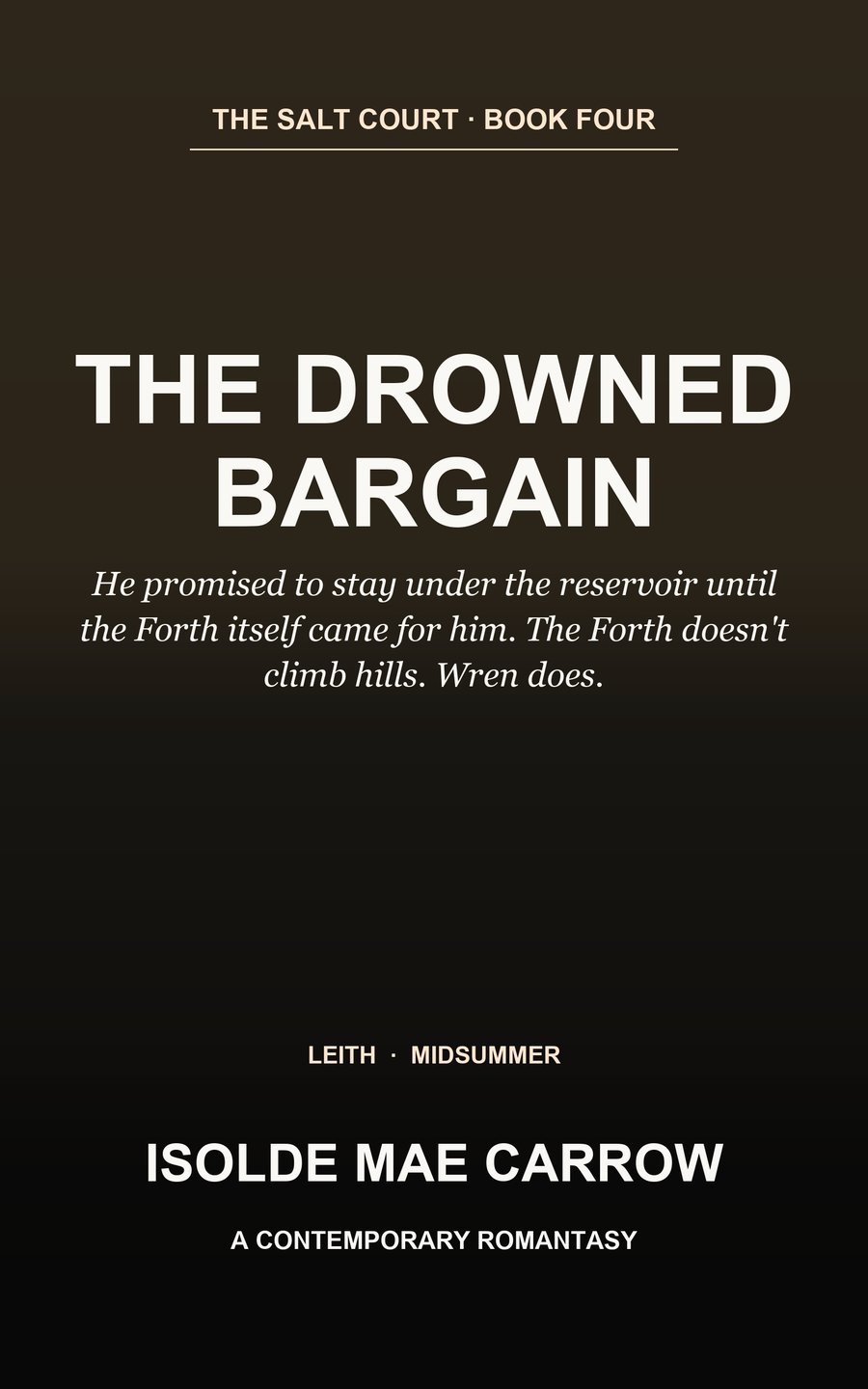
He promised to stay under the reservoir until the Forth itself came for him. The Forth doesn't climb hills. Wren does.

· The Salt Court, book 4 · Fantasy

Wren Balfour is the Queen of the Ebb for a year and a day. She works for the council's coastal team in Leith, she's engaged to a two-hundred-year-old ferry engineer who cannot tell a lie, and she has a stone in her pocket from under a reservoir that says: At midsummer, he'll ask for you. Don't come.

Read the full descriptionShow less

Then the Water of Leith starts running backwards at night. The Salt Court's spring under Leith Shore turns sweet, and the oldest of the court begin to cough in their niches. The lord of the Hollow wants Ronan, and he's found two things Ronan wants more than himself.

So Ronan makes a bargain at the meeting of the waters: he'll go under Harlaw and stay there until the Forth itself comes for him.

The Forth doesn't climb hills. But an old law says where the Ebb walks, the Forth walks. Wren has a borrowed flask, the shortest night of the year and twelve miles of road to cover. Every cold line she crosses between the Shore and the Pentlands will cost her a year of her life.

• A contemporary romantasy of selkies, sweet-water lords and very literal promises, set in present-day Edinburgh. • Found family, a council spreadsheet, and a heroine who says excuse me to the drowned. • Sensual, not explicit. Book 4 of 5 in The Salt Court: read books 1 to 3 first.

For readers who love bargains with loopholes, sea magic and a love that pays its own way.

£4.99 · 149pp View book Free sample

The Hollow Court is coming down the river. The Queen of the Ebb has a spreadsheet and a wedding date.

· The Salt Court, book 5 · Fantasy

Wren Balfour, council flood engineer and Queen of the Ebb, has twenty-two days. At the autumn equinox, Aonghas of the Hollow Court will come down the Water of Leith with every loch, burn and reservoir in the Pentlands, and try to turn the Salt Court's spring sweet to the bottom. This year the equinox falls on a neap, when the sea is at its weakest. He planned it that way.

Read the full descriptionShow less

He also has her grandmother, chained in silver under a dam since 1978.

What Wren has: a court of forty, a colleague with a spreadsheet and a man at Scottish Water who owes her two favours, a boss who has booked the Shore for a "flood exercise", and two hundred flasks. There are sixty drowned people in the river who want to go home, and a song she hasn't sung in front of anyone since she was seven.

And Ronan Seil, who cannot lie, has worked out what opens silver. He hasn't told her the price.

The last book of the Salt Court: a war fought with taps and flasks, a bargain made at the top of the tide, and a wedding the day after they win.

• Contemporary romantasy set in present-day Leith and the Pentland Hills. • Sensual, not explicit. Selkies, a river lord, a council engineer, and a love that chooses to grow old. • Book five of five. The series finale.

£4.99 · 139pp View book Free sample

Roselyn Denise Chambers 2 books

A lighthouse for sale, a man from Boston, and a lens that throws no rainbows

· Chambers Abroad, book 1 · Contemporary Romance

She holds the keys. He came to take them. Somebody else already has a copy.

Read the full descriptionShow less

Hallie Sorensen runs the tiny museum of Pell Harbor, Maine, and she holds the keys to Tern Point Light. The day after Labor Day, the government sells the lighthouse at auction. Her little historical society, run by a retired teacher in a bow tie and fed by a church pie committee, means to buy it and keep it open to everyone.

Then Nate Whitaker drives up from Boston. He is an architect, he is seasick, he puts mayonnaise on a lobster roll, and he has come to survey the tower for the man who wants to turn it into a luxury inn.

On his first morning, he finds that somebody has been loosening the railing forty feet above the rocks.

Somebody else has a key. The great glass lens in the town museum no longer throws rainbows. A report says the tower is falling down, and it isn't. And the Society's money is not where it should be. With the auction clock running down, an enemy from Boston turns out to be the only person in town who can read a set of plans, and a very bad sailor ends up in a lobster-boat race.

Last Light at Tern Point is a warm, funny Maine romance: enemies to lovers in the fog, a real mystery with a deadline, a lobsterman grandfather of eighty-one who will not stay off the water, and a church pie committee run like a cartel.

For readers who want:

• Enemies to lovers with a clock ticking • A small-town mystery with the money in plain sight • Maine at the end of summer: fog, lobster rolls, a boat race and a lighthouse • A whole town of characters, including a Newfoundland dog who is afraid of gulls • A happy ending that has to be earned

A standalone novel with a happy ending.

Sensual, not explicit: one love scene, implied and never described. Mild language. A grandparent's death before the story begins; danger at sea.

£6.99 · 192pp View book Free sample

Two bakeries, one Carnival crown, and a debt that won't stay forgiven

· Chambers Abroad, book 2 · Contemporary Romance

Whoever finds the baby buys the next cake. Somebody wants the whole bakery.

Read the full descriptionShow less

For forty-one years, Fontenot's Bakery on Magazine Street has baked the official king cake of the Krewe of Mirabelle. Delphine Fontenot braids it the way her grandmother taught her at the age of seven: four strands, never three.

Then Owen Mercer opens across the street. He is a burned-out Chicago pastry chef with his late grandmother's recipe box and a three-strand braid. On Twelfth Night, the blind tasting goes to him.

That same morning, the krewe's captain calls in a debt on Delphine's bakery that her father swore was forgiven, and gives her until Ash Wednesday to pay.

The forgiving letter is somewhere in the building. Her father hid it "under the lid," and she has opened every lid she owns. Somebody switches off her walk-in in the night. A page goes missing from the krewe's minute book. And when the float barn burns, Delphine and Owen are inside it.

King Cake Rules is a warm, funny New Orleans romance: rivals to lovers across one street, a real mystery with a Carnival deadline, a grandmother who rigs the king cake baby, a pink costume nobody should have to wear in public, and an elderly parrot who knows a great deal more than he is saying.

For readers who want:

• Rivals to lovers, with flour on everything • A small-business mystery with a deadline and a paper trail • New Orleans at Carnival: parades, brass bands, king cake and Mardi Gras morning • A whole street of characters, including a parrot who tells tall men to go to hell • A happy ending that has to be earned

A standalone novel with a happy ending.

Sensual, not explicit: one love scene, implied and never described. Mild language. A parent's death before the story begins; a fire.

£6.99 · 227pp View book Free sample

For writers

Start writing your eBook

Write it chapter by chapter, right here. It saves as you go, and turns into an EPUB when you are done.

Start writing

EYDP · eBookYou Direct Publishing

Publish it. Keep 70%.

Sell your eBook here and keep 70% of every sale, in every country. Every eBook gets its own EYSIN.

How publishing works

Know when the next one lands

New releases only. No schedule, no marketing sequence, and you can leave in one click.

Feedback